





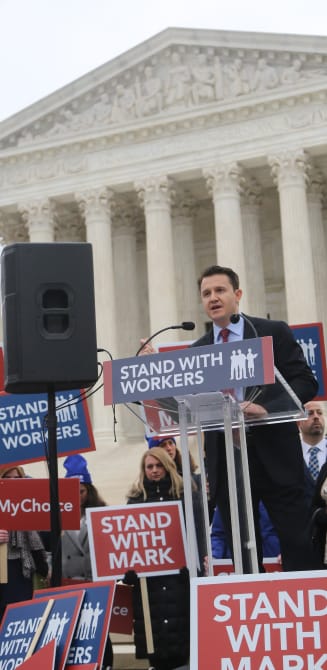

Can the state recognize an “exclusive representative” to speak to the government on your behalf—even if you didn’t choose it yourself and don’t want it? That’s the question a Goldwater Institute amicus brief is asking the U.S. Supreme Court to decide in Bierman v. Dayton.
The plaintiffs are eight Minnesota parents, each of whom provides around-the-clock personal care to a severely disabled son or daughter at home. To help cover their expenses and prevent their children from being placed in an institution, these parents receive modest financial assistance through a state-run Medicaid program.
In 2013, Minnesota passed a law authorizing the government to recognize an exclusive representative—that is, a union—to bargain with the state on behalf of these parents and others who receive benefits through the program. Soon afterward, the state recognized a unit of the Service Employees International Union as the caregivers’ exclusive representative—and it began taking money out of their Medicaid checks and giving it to the union.
Minnesota is just one of fifteen states have passed laws like this that authorize an exclusive representative to speak on behalf of private citizens simply because they receive government money for their services.
The Supreme Court ruled that forcing caregivers like these to pay union fees is unconstitutional in 2014. But that decision only ended the forced fees—it didn’t stop the unions’ exclusive representation of these private citizens.
This case asks the Court to end the exclusive representation as well. Appointing an official representative to speak for a group of citizens, whether they want it or not, violates their First Amendment right to choose which groups they will and won’t associate with.
As the Goldwater Institute’s brief explains, when our country’s founders designed the Constitution, they sought to limit the influence of “factions”—that is, of interest groups that would use the government to serve their own interests rather than the public interest. Today, public-sector unions have all the characteristics of a faction. And when the government enacts laws like Minnesota’s that force citizens to accept a public-sector union to speak for them, it creates and empowers dangerous new factions and undermines our republican system of government.
Timothy Sandefur is the Vice President for Litigation at the Goldwater Institute’s Scharf-Norton Center for Constitutional Litigation and holds the Duncan Chair in Constitutional Government. He litigates important cases for economic liberty, private property rights, and free speech in states across the country.
Timothy is the author of several books, including Frederick Douglass: Self-Made Man (2018), Cornerstone of Liberty: Property Rights in 21st Century America (coauthored with Christina Sandefur, 2016), The Permission Society (2016), The Conscience of The Constitution (2014), and The Right to Earn A Living (2010), as well as dozens of scholarly articles on subjects ranging from Indian law to antitrust, slavery and the Civil War, and political issues in Shakespeare, ancient Greek drama, and Star Trek.
He is an Adjunct Scholar with the Cato Institute and is a graduate of Hillsdale College and Chapman University School of Law.
Jacob Huebert is a Senior Attorney at the Goldwater Institute, litigating cases on free speech, property rights, and the Second Amendment.
Jacob currently leads the Goldwater Institute's First Amendment challenges to state laws that require attorneys to join and pay dues to a bar association. He also has represented four law-abiding Chicago-area residents seeking to reclaim their Second Amendment rights in a lawsuit challenging the state of Illinois’s long delays in issuing licenses to possess firearms.
Before joining Goldwater, he served as Director of Litigation for the Liberty Justice Center in Chicago. There, he successfully litigated cases to protect economic liberty, free speech, and other constitutional rights, including the landmark Janus v. AFSCME case, in which the U.S. Supreme Court upheld government workers’ First Amendment right to choose for themselves whether to pay money to a union. Jacob and his work have appeared in numerous national media outlets, including the Wall Street Journal, New York Times, and Fox News Channel.
Jacob holds a B.A. in economics from Grove City College and a J.D. from the University of Chicago Law School. After law school, Jacob served as a clerk to Judge Deborah Cook of the U.S. Court of Appeals for the Sixth Circuit.